Members of the Utes’ defensive line wait for the snap during spring drills at the University of Utah in Salt Lake City. | University of Utah Athletics
The focus during spring, said coach Sione Po’uha, is helping his players, especially the younger ones, sharpen their technique and fundamentals
Perhaps what’s most notable about Utah’s defensive line is its depth and experience.
This spring, it also means a lot of competition.
And that’s great news for the Utes’ defense.
“It’s good to build competition,” said defensive tackles coach Sione Po’uha. “You have guys that have experience and you have younger guys and everybody in between. It can be challenging but we’ve been able to position it in a way where we can create competition.”
The depth chart lists junior Mika Tafua, sophomore Brant Kuithe and freshman Xavier Carlton at left end; senior Viane Moala and junior Devin Kaufusi at left tackle; senior Maxs Tupai, freshman Van Fillinger and freshman Miki Suguturaga at right end.
“It brings a lot to the table with a lot of the guys coming back because that means we have experience,” Tupai said. “That’s going to help us overall.”
University of Utah Athletics
Utah defensive lineman Maxs Tupai gets in some work during spring drills at the University of Utah in Salt Lake City. The Murray High product looks to bring his senior leadership to the right end position.
“There’s a lot of good competition. There’s about nine of us this spring. Everybody’s getting a lot of reps. The competition helps,” said Hauati Pututau. “There’s still a lot of young guys but that experience that we have coming back is helping a lot smooth things out and show the young guys how it’s going to go.”
The focus during spring, said Po’uha, is helping his players, especially the younger ones, sharpen their technique and fundamentals.
“We had kind of an abbreviated season last year, which gave them a chance to get their feet wet a little bit,” he said of the freshmen. “But now, going through the full cycle, going through spring ball, they’re able to get the sharpening practices from a spring season that we’re having right now … and also getting a little bit more drenched in the playbook and understanding the whole philosophy of how we play defense here.”
Coach Kyle Whittingham has talked about a pair of freshmen — Fillinger and Carlton. Fillinger saw action in five games in 2020, while Carlton played in four games.
“They continue to get better and bigger as well. Van and X are both over 260 (pounds),” Whittingham said. “When we got them they were in the 240 range. Their knowledge of the scheme has obviously increased. They’re doing a nice job. They’re much improved from where they were last fall.”
Meanwhile, Kaufusi, a transfer from BYU, and the younger brother of former Cougar defensive line stars Bronson and Corbin Kaufusi, has moved from end to tackle.
“I think when you have any Kaufusis, you put them anywhere,” Po’uha said. “He’s taken it pretty naturally but I think he’s been really intentional on getting better at that position of being a defensive tackle, moving from the outside in. He’s got a great work habit, a great attitude. For him, because of his ability, he’s intentionally trying to get better with every practice.”
Moala is one of the seniors that opted to return for another season of college football.
“I feel like we’ve got something special going on this year,” he said. “I really didn’t have a full season so it was a no-brainer for me to come back.”
On Friday, the Utes will hold their first scrimmage of the spring.
“We’ve been going at it for a couple of weeks now,” Po’uha said. “I’m looking forward to seeing how they react to situational football. That’s one of the main goals of having these scrimmages.”
Former BYU receiver Micah Simon, shown here in a 2019 game, shined at BYU’s pro day last week on March 26, 2021, and caught the attention of the Carolina Panthers. Simon signed a three-year deal with the Panthers on Tuesday, March 30. 2021. | Robert W. Grover
Defensive tackle Khyiris Tonga, receivers Micah Simon and Dax Milne, tight end Matt Bushman and cornerback Chris Wilcox also improved their draft stock with solid showings at BYU pro day in Provo on March 26
Four weeks from now, the 86th NFL draft will begin on April 29 across iconic locations in downtown Cleveland, and every 2021 NFL draft analyst in the country is saying BYU quarterback Zach Wilson will hear his name called in the first round, perhaps as early as the No. 2 pick — to the New York Jets.
Another BYU player who completed his junior season last December when the Cougars rocked Central Florida 49-23 in the Boca Raton Bowl and then declared for the draft a few weeks later, uber-athletic left tackle Brady Christensen, is hoping to be selected on April 30, when the second and third rounds are held, but will probably go in rounds four or five on May 1, most experts say.
Other participants included Zayne Anderson, Zac Dawe, Kavika Fonua, Isaiah Kaufusi and Cougars who, like Simon, exhausted their eligibility in 2019 but did not have a pro day last year due to the COVID-19 pandemic: Isaiah Armstrong, Aleva Hifo, Batchlor Johnson IV, Austin Lee and Beau Tanner.
Defensive tackle Bracken El-Bakri fell ill the night before the event and was only measured, checking in at 6-foot-1 and 280 pounds, while safety Troy Warner, 6-foot-1 and 200 pounds, sustained a pectoral muscle injury while doing bench presses and was unable to continue.
After the proceedings, NFL Network analyst Daniel Jeremiah said it was one of the most effectively planned and organized pro days he’s attended and applauded BYU for the effort. He was also impressed by the depth of this year’s departing class.
“I think (NFL teams) know when they get a BYU kid, they are getting a really tough kid,” Jeremiah said. “The best thing that can happen for a program, in my opinion, is when you have a marquee quarterback, because it just gives you so much exposure.”
Scott G Winterton, Deseret News
LSU Tigers defensive back Donte Jackson (1) brings down BYU wide receiver Micah Simon (13) as BYU and LSU play in the Mercedes-Benz Superdome in New Orleans on Saturday, Sept. 2, 2017.
With Carolina general manager Scott Fitterer and offensive coordinator Joe Brady on hand to watch Wilson, presumably, Simon clocked a 4.34-second 40-yard dash, then ran routes and caught some of the 60 or so passes that Wilson threw a few minutes later.
Jeffrey D. Allred, Deseret News
BYU defensive back Chris Wilcox defends Arizona wide receiver Shawn Poindexter in Tucson on Saturday, Sept. 1, 2018.
Wilcox works his magic
Another player who showed blazing speed at BYU’s Indoor Practice Facility was cornerback Chris Wilcox, who opted out of the bowl game last December and obviously made the most of the extra training time. On the tall side for a corner — Wilcox is 6-2 and 198 pounds — the senior who graduated last April ran a day’s best 4.31 in the 40 and also posted a 37.5-inch vertical jump and a 10-foot, 6-inch broad jump, which was only bettered by Hifo (10 feet, 7 inches).
“That was the goal all along,” Wilcox said of his 40 time. “The fastest I had hit was like 4.40. I knew when I saw all the coaches in front of me and the adrenaline was pumping, that the goal (was attainable), for sure.”
Wilcox, who has signed with Athletes First and agent Andrew Kessler, said he has talked to “over half” of the 32 teams in the NFL since December when he decided he didn’t want to risk injury and play in the bowl game.
“Today was a day to get my name out there, and I knew I had to make a big statement today. I feel like I did,” Wilcox said. “We will just see how it goes from here. I talked to a couple scouts after and I feel like they liked the results. … I just wanted to show them that I am physical, that I can be a press man corner for a team. And that they are just going to get a dawg if they give me a chance.”
Scott G Winterton, Deseret News
Hawaii Warriors quarterback Cole McDonald is sacked by BYU defensive lineman Khyiris Tonga (95) as BYU and Hawaii play at LaVell Edwards Stadium in Provo on Saturday, Oct. 13, 2018.
Tonga trims down, turns in 35 reps
Another defensive player who shined was Tonga, the nose tackle who probably would have been drafted last year but returned for his senior season and helped the Cougars hold opponents to 317.4 yards per game, 10th-best in the country. Having slimmed down to 325 pounds through some intense workouts in Florida the past few months, Tonga had 35 reps in the bench press to show he didn’t lose any strength.
“I went out to Florida at 335 and I got all the way down to 310,” he said. “But I didn’t feel comfortable at being that light. I tried to get my weight back in a healthy way, so I got back to 325 and I am pretty happy with this weight and the way I am moving. I feel good with it.”
The 35 reps at 225 pounds was the best of the day at BYU and ties Tonga for the fourth-most reps ever by a Cougar at an NFL combine or pro day. Fellow defensive lineman Dawe put up 33 reps, while Christensen had 30.
Tonga has signed with agent David Canter, who also represents Zayne Anderson and Kavika Fonua.
“I have talked to a good amount of teams,” Tonga said. “If I hear from (more) after pro day, I will be happy. That’s something I expect and I hope they were able to see how I was able to move today.”
Tonga ran a 5.02 40, a 7.82 in the 3-cone drill and a 4.6 in the 20-yard shuttle.
“Having Zach here definitely helped a lot,” Tonga said. “I think it helps everyone. Everyone had the opportunity to showcase their skills and guys under the radar that didn’t have the opportunity got the opportunity and everyone did well. I think today was a success for everyone.”
Jeffrey D. Allred, Deseret News
BYU tight end Matt Bushman celebrates his touchdown against Arizona in Tucson, Arizona, on Saturday, Sept. 1, 2018.
Don’t sleep on Matt Bushman
Bushman, the 6-foot-5, 245-pound tight end who missed the entire 2020 season with a ruptured Achilles was another Cougar with a lot to prove. He bypassed the 40 and the broad jump because he didn’t have time to work on those events while he rehabbed the past six months since surgery, but he put up a 32.5-inch vertical and did 23 bench presses.
He also ran routes and caught passes from Wilson, showing off the “honey hands” that marked his first three seasons at BYU when he was fully healthy.
“I think my film just speaks for itself and will help me out,” Bushman said. “The biggest question was, ‘What will he be able to do today? How will he look running routes, or doing position drills?’ I think being able to go out there and run routes and go through the script with Zach and the other receivers showed, ‘Hey, I am not that far off.’ And I am basically back. So that was super helpful.”
“I have talked to plenty of teams, and they have said I have film from the past, and they know how to analyze film,” he said. “They know I can play. So the biggest question was my Achilles and I was able to show them I am back and I will be ready by training camp, preseason, whatever. I will be ready for it.”
Bushman is married to the daughter of former Philadelphia Eagles tight end Chad Lewis and has leaned on BYU’s associate athletic director for development to guide him through the draft training process.
“He is a great guy to lean on,” Bushman said.
Steve Griffin, Deseret News
BYU wide receiver Dax Milne (5) hauls in a long pass over North Alabama Lions cornerback Will Singleton (4) during a game in Provo on Saturday, Nov. 21, 2020.
Milne is Mr. Reliable
Another high-producing BYU pass-catcher who was part of Wilson’s script last week, the 6-foot, 193-pound Milne, didn’t show blazing speed in the 40 for a receiver, clocking in at 4.54 seconds, but was able to show off his precise route-running skills and dependable hands.
“I did have good times, but I wanted to do better,” he said. “My 40 was just about what everyone thought I would get, and I am proud of that. Overall, it was a pretty good day for me.”
Milne’s agent is Collin Roberts of REP 1 Sports.
“I think what will set me apart from other receivers coming into the league is my ability to pick up the playbook and be a fast learner,” said the former Bingham High product. “I did a good job with that coming into BYU and another physical thing that will set me apart is my ability to get separation and finish the play. Having reliability and good hands is what it is all about as a receiver in the league.”
Laura Seitz, Deseret News
BYU Chandon Herring gives a warning to Idaho State Bengals defensive lineman Gilbert Varela (98) at LaVell Edwards Stadium in Provo on Saturday, Nov. 16, 2019.
Herring, Hoge helped themselves, too
Herring, the offensive lineman, checked in at 6-foot-6.6 and 307 pounds and posted a 4.94 time in the 40. He did 26 bench presses and has Orem-based Evan Brennan as an agent. Herring’s versatility is a strength, having played guard and tackle at BYU and having also shown the ability to play center, if needed.
Herring turned some heads at the College Gridiron Showcase in Fort Worth, Texas, in January and at 25 is a bit older than the average college senior, having served a two-year mission for The Church of Jesus Christ of Latter-day Saints before his four seasons at BYU, but his physical and mental maturity could be seen as a strength, noted Dane Brugler of the Athletic.
Hoge is another senior from BYU’s outstanding O line in 2020 who would hear his name called in the later rounds of the draft, or go the undrafted free agent route. Battles with COVID-19 and pneumonia limited his playing time in 2020.
Now-Rep. Burgess Owens talks to reporters during an election night event for Republican candidates at the Utah Association of Realtors building in Sandy on Tuesday, Nov. 3, 2020. | Spenser Heaps, Deseret News
I was quite dismayed to hear the harsh language used by Rep. Burgess Owens on the national Fox News recently.
He called President Joe Biden a “dictator.”
As for Black Lives Matter, the movement seeking to stop police shootings of African Americans, Owens said this: “They hate God. They hate capitalism and they hate the family.”
This is the kind of language that led to the horrific Jan. 6 insurrection at the Capitol. We should be able to agree to disagree without this kind of ugly language that serves to divide America at a time when we need desperately to heal.
As the Founders explained, democracy only works if everyone involved puts it before party or personal gain. Owens should be reminded that this is not a football game with winners and losers. We are all in this together.
President Joe Biden speaks about the COVID-19 pandemic during a prime-time address from the East Room of the White House, Thursday, March 11, 2021, in Washington. Thirteen states, including Utah, sued Biden’s administration on Wednesday over a rule in the federal stimulus that prohibits states from using coronavirus relief money to offset tax cuts. | Andrew Harnik, Associated Press
Attorneys general from 13 mostly Republican states, including Utah, sued President Joe Biden’s administration on Wednesday over a rule in the federal stimulus that prohibits states from using coronavirus relief money to offset tax cuts.
The lawsuit filed in U.S. District Court in Alabama seeks to strike down the provision in the massive relief package signed by Biden that bars states from using $195 billion of federal aid “to either directly or indirectly offset a reduction” in net tax revenue. The restriction could apply through 2024.
The coalition, which includes one Democratic attorney general, is concerned the provision can construe any tax cut as taking advantage of the pandemic relief funds, according to the Associated Press.
“The Utah Legislature recently passed $100 million in tax relief to families with children, veterans and older residents receiving Social Security,” Reyes said in a statement in mid-March. “But that relief is now at risk because the American Rescue Plan Act potentially denies states the ability to cut taxes.”
The Treasury Department at the time said the provision isn’t meant as a blanket prohibition on tax cuts, the AP reported. States can still offset tax reductions through other means.
“Nothing in the Act prevents states from enacting a broad variety of tax cuts,” Yellen wrote in response to the letter. “It simply provides that funding received under the act may not be used to offset a reduction in net tax revenue resulting from certain changes in state law.”
But West Virginia Attorney General Patrick Morrisey, who co-led the lawsuit with his colleagues from Alabama and Arkansas, argues the interpretation of the word “indirectly” in the provision could come back to haunt states that cut taxes.
“This ensures our citizens aren’t stuck with an unforeseen bill from the feds years from now,” he said in a statement.
Alabama Republican Attorney General Steve Marshall said the “federal tax mandate is an unprecedented and unconstitutional assault on state sovereignty.”
Alaska, Florida, Iowa, Kansas, Montana, New Hampshire, Oklahoma, South Carolina and South Dakota also signed onto the lawsuit. Ohio Attorney General Dave Yost, a Republican, earlier this month separately asked a federal judge to block the tax cut provision.
Several state legislatures are weighing tax reform this year, which is partly driving the lawsuit.
West Virginia lawmakers are hurrying to approve a cut to the state income tax before their 60-day session ends on April 10. Montana’s GOP-controlled statehouse is considering several tax cut bills. Its Republican Attorney General Austin Knudsen said “it’s a slap in the face to Montana” to limit how the stimulus funds can be used, according to the AP.
Yellen, whose department declined new comment, had said in her letter that “it is well established that Congress may place such reasonable conditions on how states may use federal funding.”
The nonprofit Tax Foundation said in a new report this week that it’s more likely the Treasury Department would opt for a “narrow interpretation that does not unduly tie states’ hands” in enforcing the provision, the AP reported.
“Most states are likely at minimal risk regardless of the tax policy choices they make,” it said. “For now, however, uncertainty persists, and lawmakers must operate within that uncertainty.”
John Valentine, chairman of the Utah State Tax Commission and president of the Federation of Tax Administrators, earlier told the Deseret News he’s concerned about numerous “ambiguities” in the COVID-19 relief act. In particular, he said the act doesn’t define a time period, throwing into question at what point a state could enact a tax cut without having to return that amount in federal aid.
“So instead of $100 million, which is one year’s worth of (Utah’s tax) reduction, is it now $300 or $400 million?” Valentine said, questioning if the life of the bill is one year, two years, or maybe even three or four years. “We don’t know. This is what we call ambiguities in the law. We just don’t know.”
Valentine noted that Utah’s tax-cut package this year was two years in the making, with $80 million set aside last year. Lawmakers this year added $20 million, all from the state’s own ongoing revenue.
The lawsuit is the second against the Biden administration in which Reyes has involved Utah.
Utah joined a dozen other states last week in a lawsuit against challenging an executive order Biden issued to ban any new oil and gas leasing on federal land and offshore waters.
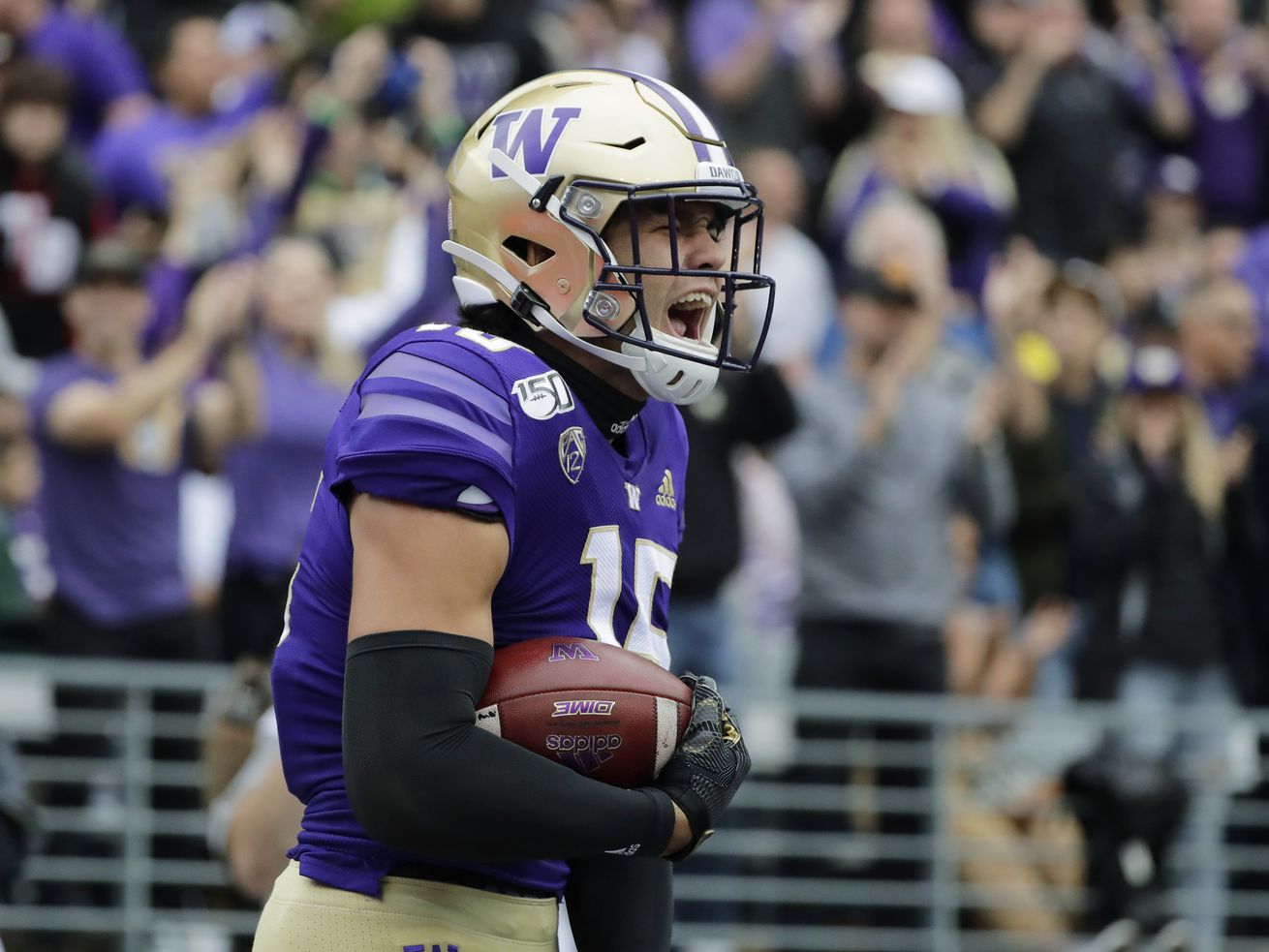
Washington’s Puka Nacua and Utah’s Samson Nacua have officially signed with BYU after transferring to their hometown school to be closer to family
BYU’s receivers group just got a lot better.
Head coach Kalani Sitake announced Wednesday that brothers Puka and Samson Nacua, from the University of Washington and University of Utah, respectively, have signed scholarship agreements to transfer to BYU.
Wednesday’s announcement is not a surprise; The Nacuas said on March 8 via social media accounts that they were transferring to BYU. Samson Nacua enters as a graduate transfer and a senior in 2021, while Puka Nacua is listed as a sophomore — with three seasons of eligibility remaining if he wants them.
Samson Nacua is immediately eligible as a graduate transfer; Puka Nacua will be eligible in 2021 as a first-time transfer if the NCAA passes pending legislation that will allow first-time transfers to be immediately eligible, as expected.
“We are very excited about the additions of Samson and Puka,” Sitake said in a school news release. “They are both experienced and talented receivers and come from an amazing family and a great bloodline of football players to come through BYU. Their character and leadership will be a great asset to our program and university and will add to the great culture that has already been established here at BYU.”
The brothers are the sons of Penina and the late Lionell Nacua. Older brothers Kaimana and Isaiah also attended BYU and were a part of the football program. Kai Nacua played at BYU from 2013-16 and is currently in the NFL with the San Francisco 49ers.
Puka Nacua was a first-team All-American and the Deseret News’ Mr. Football out of Orem High School in 2018. He averaged 19.9 yards per reception for the Huskies in his two seasons while totaling 319 yards and three touchdowns on 16 receptions. He played in 11 games overall in two abbreviated seasons in Seattle.
Samson Nacua played in 45 games for Utah, including eight starts, while totaling 1,015 yards and 11 touchdowns on 82 receptions from 2017 to 2020. He was a first-team All-State player out of Timpview High.
The brothers joined group of receivers for receivers coach and passing game coordinator Fesi Sitake that will lose Dax Milne to professional football but has Gunner Romney, Neil Pau’u, Chris Jackson and others returning from a team that went 11-1 and finished ranked No. 11 in the final AP Top 25 poll.
A hand-painted sign on a business in downtown Salt Lake City on Monday, April 13, 2020, reminds Utahns to social distance during the COVID-19 pandemic. | Steve Griffin, Deseret News
A new program hopes to help more businesses recover from the COVID-19 pandemic.
This week, Salt Lake County is launching the Economic Inclusion Community Assistance Program aimed at mitigating the K-shaped economic recovery resulting from the effects of the coronavirus pandemic.
Business Insider characterizes a K-shaped recovery as a scenario where certain industries and individuals pull out of a recession, while others stagnate, basically splitting an economy in two with separations “along class, racial, geographic or industry lines.” The K-shaped recovery typically reveals previous variances and inequities in wealth that can be exacerbated.
In the wake of the economic turmoil caused by the pandemic, the county is seeking to address those gaps in connecting diverse business owners with existing resources that have otherwise gone underutilized or unknown to potential small business recipients, said Salt Lake County Economic Development Director Jevon Gibb.
”The gaps that existed before the pandemic are becoming even wider coming out of the pandemic, and a lot of the problem is about inclusion because the companies and communities that are falling further behind faced issues of inclusion beforehand,” he said.
COVID-19 Economic Recovery Program Manager Samantha Mary Thermos said county leaders want to leverage community organizations’ relationships to help connect diverse businesses with the support they need to recover from the pandemic’s effects and achieve long-term success.
“We believe community partners have the existing relationships, established networks and cultural awareness necessary to effectively assist diverse business owners experiencing the devastating financial impacts of the pandemic, and this program will facilitate that one-on-one connection,” she said.
The program is being developed to fund partners that work with businesses in communities experiencing economic opportunity gaps, including African American, Asian American, Hispanic, Native American, Asian-Pacific, women, persons with disabilities, veterans, socially or economically disadvantaged businesses, and businesses located in areas with lower economic opportunity, Gibb said.
“We still have important work to do around inclusion. Some communities are getting left behind, and COVID-19 has made that trend worse,” Gibb said. “All too often, this lack of opportunity goes overlooked. We’re excited to work with partners to help these communities achieve their potential, which will create a stronger economy for everybody in Salt Lake County.”
The county currently has allocated $200,000 that will be used to fund trainings through partnerships with nonprofit organizations who will work as facilitators and provide assistance to small businesses that may need help in fostering the relationships required to prosper long term, she said.
“Our role would be to add capacity or money to provide more trainers or facilitators to pay nonprofits to seek answers, and as that works through, we hope that companies can do things like have a better banking relationships with their financial institution.
“Maybe they don’t understand how banking works in the U.S., so (we might have) a facilitator sit down with them and explain how banking works and what kind of records they need to keep,” Thermos said.
In addition to introducing them to a bank that understands their needs, help could include something like “Excel classes, basic business needs, but then there’s also specific needs — maybe it’s a day care facility,” she said.
“We know that women are an unfortunate example of how the recovery has been very tough and funding nonprofits to help train day care providers and day care centers to add capacity is huge,” she added. “That’s been a big hit in the economy, and so if we can help with some of those specific things, that would be an example of those (needs to be met).”
Gibb said the initial program funding rollout is targeted for six months, upon which time the county will evaluate any changes or adjustments that could be made to improve its functionality. The hope is to develop in a way that will be an asset to diverse business enterprises for years to come, he said.
“We’re talking about opportunity communities, and opportunity business enterprises,” he said. “That’s being defined as communities that have experienced less economic mobility or economic opportunity in the past.”
“We’ve taken a flexible approach there, but with the underlying goal of ‘Help us understand how this community has experienced economic opportunity gaps in the past and how you’re going to work on that,’” he explained. “It’s not just one characteristic that we’re going to say, ‘Yes, then you qualify.’ It’s open to (interpretation). Issues about the kind of opportunities you face are complex, and so we’re going to take that flexible approach to understand that complexity.”
Former President Donald Trump addresses attendees during the 2021 Conservative Political Action Conference at the Hyatt Regency. | Paul Hennessy, SOPA Images/Sipa
We can plug our ears, cover our eyes, and will him to go away. But the reality is, Trump is still a big problem worth covering.
“Please stop covering the crazy stuff out Trump’s mouth (sic). The nightmare is over. Please #CNN, #NBC, #CBS, #ABC.”
That’s just one of probably thousands of similar tweets in recent months imploring the media to just ignore the former president and, to invoke a Bush-era mantra, move on.
“I can not say this enough. Stop covering donald trump. We don’t care,” read another.
“MSM STOP COVERING TRUMP. HE IS IRRELEVANT.”
The frustration is ALL-CAPS PALPABLE. After four years of round-the-clock coverage of a president who willingly inserted himself into all aspects of American life, sometimes tweeting in the middle of the night, it’s understandable that voters and viewers want a break.
It was part of Joe Biden’s direct appeal, to be less visible and less invasive. “Remember when you didn’t have to think about the president every single day?” a Biden September 2020 ad began.
I’m here for a post-MAGA America, one that resides permanently within a history book and not in a newspaper, but we don’t yet live in that America. I’m sad to say, Trump is not “irrelevant”; the “nightmare” is not over.
For one, he’s trying to influence the 2022 midterms and is likely to play a significant role in Republican efforts to win back Congress. Considering Biden’s substantial and fragile agenda, that seems, er, important.
Likewise, Trump may very well run for president again in 2024. And if you want to know what it looks like when the media doesn’t take a presidential run seriously, see the early months of 2016 and the eventual result.
After being de-platformed on multiple social media sites, he plans to launch one of his own. According to former adviser Corey Lewandowski, the site promises “an opportunity for other people to weigh in and communicate in a free format without fear of reprisal or being canceled.”
He has also just launched a new official website, 45office.com, where Trump supporters can request “participation in events, submit letters and ask for personalized greetings.”
He has established a leadership PAC, Save America, and is reportedly launching a super PAC, which can raise and spend unlimited amounts of money.
In short, this doesn’t sound like someone who is going away. And with the money he has already raised, his impact isn’t either. Covering Trump’s potential kingmaking will be an important and ongoing part of the media’s job. Ignore it at your own peril, and talk to me in November of 2022.
But the more alarming aspect we simply cannot afford to ignore is Trump’s continued influence over culture.
It wasn’t PACs or super PACs that catapulted Trump to power. It was his politics of revenge and grievances, a fetid cauldron of racism, bigotry, sexism, xenophobia, perverted populism and nihilism. All that hasn’t gone away.
While many Republicans left the party in droves over Trump’s divisive rhetoric and policies, a sizable amount have remained and calcified — nearly 26% of the country identifies as Republican — more than enough to sway elections. What those voters believe in may trouble us. But pretending they don’t exist is, I promise, not the answer.
Trump’s influence on them is well worth covering. After all, it helped shape their opinions on COVID-19 — his anti-mask and anti-science rhetoric inarguably prolonged and worsened the pandemic.
Trump is still trying to stoke their skepticism. In a statement he just released this week, Trump calls his own scientists Dr. Deborah Birx, “a proven liar,” and Dr. Anthony Fauci, “the king of ‘flip-flops.’” He collectively calls them “two self-promoters trying to reinvent history to cover for their bad instincts and faulty recommendations, which I fortunately almost always overturned.”
Just as dangerously, he’s still spreading the big lie that his election was stolen. That lie has become so fundamental to the Republican Party that Georgia just turned it into a law.
And Trump’s reawakening of white supremacist elements in the United States resulted in an insurrection at the Capitol just under three months ago, along with a rise in far-right extremism. If we agree we must root out hatred and systemic racism, we must also cover the people promoting it, including Trump.
Believe me, no one wants to be past Trumpism more than I do. It has been one of the ugliest eras of modern American history, the lasting effects of which are nowhere near complete.
And it’s because the story is unfinished that we must continue covering it. As NPR public editor Kelly McBride put it, “It’s virtually impossible to stop talking about Trump. There’s still too many questions about what he did as president.”
We can plug our ears, cover our eyes and will him to go away. But the reality is, Trump is still a big problem for America — and yes, a problem worth covering.
S.E. Cupp is the host of “S.E. Cupp Unfiltered” on CNN.

/cdn.vox-cdn.com/uploads/chorus_asset/file/22414489/Tupai_Maxs_2021Spring.jpg) University of Utah Athletics
University of Utah Athletics

/cdn.vox-cdn.com/uploads/chorus_asset/file/22414398/merlin_894980.jpg) Scott G Winterton, Deseret News
Scott G Winterton, Deseret News
/cdn.vox-cdn.com/uploads/chorus_asset/file/22414388/merlin_865299.jpg) Jeffrey D. Allred, Deseret News
Jeffrey D. Allred, Deseret News
/cdn.vox-cdn.com/uploads/chorus_asset/file/22414385/merlin_208185.jpg) Scott G Winterton, Deseret News
Scott G Winterton, Deseret News
/cdn.vox-cdn.com/uploads/chorus_asset/file/20005457/merlin_887811.jpg) Jeffrey D. Allred, Deseret News
Jeffrey D. Allred, Deseret News
/cdn.vox-cdn.com/uploads/chorus_asset/file/22065314/merlin_2842827.jpg) Steve Griffin, Deseret News
Steve Griffin, Deseret News
/cdn.vox-cdn.com/uploads/chorus_asset/file/19383099/merlin_20837.jpg) Laura Seitz, Deseret News
Laura Seitz, Deseret News